Can Artificial Intelligence Read Cursive? The 2026 Reality
The Evolution of Handwriting Recognition
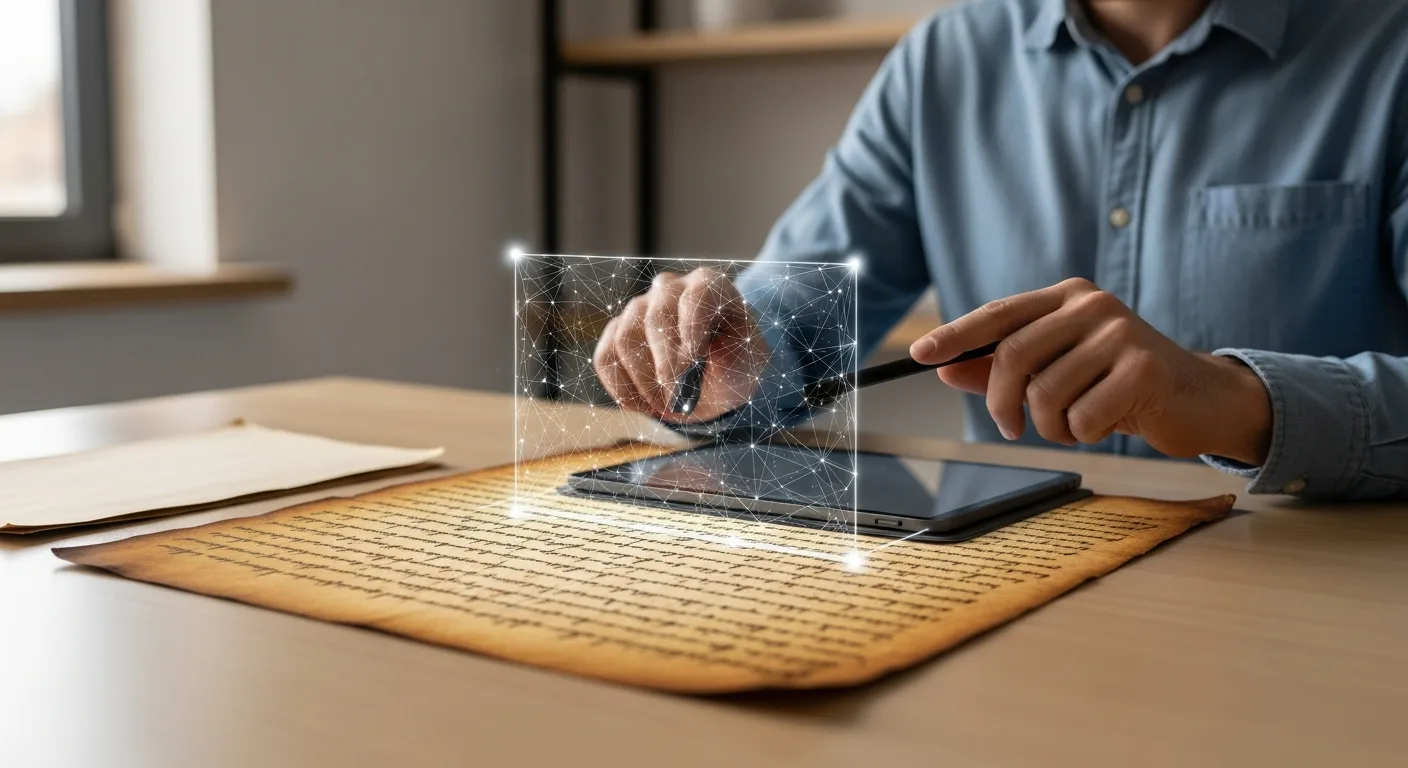
For decades, cursive was the ultimate “human” captcha. If a man wrote a note in a hurry, even his own brother might struggle to read it. But in 2026, the script has flipped. Artificial intelligence has moved far beyond basic Optical Character Recognition (OCR) and into the realm of Handwritten Text Recognition (HTR).
Early systems tried to identify individual letters by their shapes. This failed miserably with cursive because the letters are connected, often morphing into a single, continuous line. Today, AI doesn’t just look at the shapes; it analyzes the probability of sequences. It understands that if a man writes a word starting with “bi,” the next few loops are more likely to be “cycle” than a random string of characters.
How Modern AI Deciphers Script
The breakthrough came when developers stopped treating handwriting as a series of static images and started treating it like a language. Modern models use Recurrent Neural Networks (RNNs) and Transformers to process the data. These systems look at the entire word or sentence at once, rather than piece by piece.
By leveraging multimodal AI capabilities, these systems can now process visual inputs and linguistic context simultaneously. This means if a word is physically illegible, the AI uses the surrounding text to make an educated guess, much like a historian would when examining an ancient manuscript. He doesn’t just look at the ink; he looks at the meaning of the sentence.
The Role of Deep Learning and Context
In 2026, the most effective tools for reading cursive utilize Vision Transformers (ViT). These models break an image of handwriting into small patches and analyze the relationship between them. This allows the AI to handle variations in slant, pressure, and style that vary from one man to another.
- Slant Correction: AI can mathematically “straighten” a man’s handwriting to match standard patterns.
- Ligature Analysis: The system recognizes how specific letters (like ‘o’ and ‘r’) connect in unique ways.
- Lexicon Mapping: The AI compares the decoded script against a massive database of known words to ensure the output makes sense.
Some of the most advanced systems now use mixture of experts (MoE) architectures to switch between different sub-models depending on the style of the script. If the AI detects a highly stylized 18th-century script, it activates a “specialist” sub-network trained specifically on historical documents.
Challenges: When AI Still Struggles
Despite these leaps, AI isn’t perfect. It still faces hurdles when dealing with extreme cases. If a man writes with significant tremors or uses non-standard abbreviations that aren’t in the AI’s training data, the system may hallucinate. Hallucination in handwriting recognition occurs when the AI is so confident in its linguistic model that it ignores the visual evidence, forcing a word into the text that isn’t actually there.
Overlapping text, ink bleeds, and physical damage to the paper also present significant challenges. However, for 95% of modern and historical cursive, the AI’s accuracy now rivals or exceeds that of a human expert.
Practical Applications in 2026
The ability for AI to read cursive has unlocked massive amounts of data that were previously trapped in physical archives. Historians are using these tools to digitize centuries of personal journals, allowing a man to search his ancestor’s handwritten letters as easily as a Google doc.
In the legal and medical fields, AI is being used to transcribe old records where the handwriting was notoriously difficult to decipher. This saves thousands of man-hours and reduces the risk of human error in interpreting critical historical data.
Frequently Asked Questions
Can ChatGPT read cursive?
Yes, the latest versions of ChatGPT (specifically those with vision capabilities) are highly proficient at reading cursive. A man can upload a photo of a handwritten note, and the AI will provide a transcription with high accuracy.
Is there a free AI that reads handwriting?
Several free tools exist, including Google Lens and various open-source models available on platforms like Hugging Face. These tools allow any man to digitize his handwritten notes using just his smartphone camera.
Can AI read messy doctor’s notes?
While notoriously difficult, AI is now better at this than most humans. By using medical-specific language models, the AI can predict clinical terms even when the handwriting is extremely degraded.