
Will Artificial Intelligence Take Away Jobs? The Reality of the 2026 Labor Market
The Shift from Task Replacement to Role Transformation
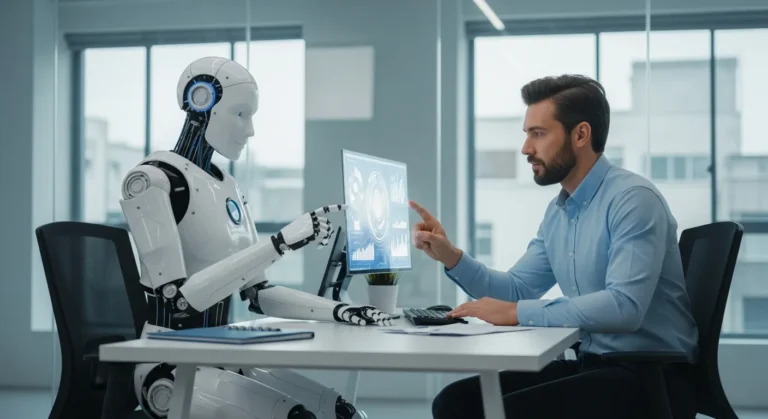
The anxiety surrounding a robotic takeover of the workforce has shifted from science fiction to a boardroom reality. However, the narrative that AI will simply “delete” human roles is an oversimplification. In 2026, we are seeing a more nuanced transition: AI is not necessarily taking away jobs, but it is aggressively deconstructing tasks. A professional who spends his day on repetitive data entry or basic scheduling will find his role shrinking, while the strategist who uses AI to amplify his output becomes more valuable than ever.
Automation focuses on efficiency, but human work focuses on judgment and accountability. While an algorithm can generate a thousand lines of code in seconds, it cannot take responsibility for a system failure or understand the ethical implications of a business pivot. The modern worker must view AI as a high-level intern—capable of doing the heavy lifting but requiring a human supervisor to provide direction and final approval.
Which Industries Face the Most Disruption?
No sector is entirely immune, but the impact varies significantly based on the cognitive and physical demands of the role. White-collar professions that rely heavily on information processing are currently in the eye of the storm. For example, the debate regarding the evolving role of developers highlights how entry-level coding tasks are being swallowed by LLMs, forcing engineers to move toward system architecture and high-level problem solving.
- Customer Service: Tier-1 support is almost entirely handled by autonomous agents that can resolve issues without human intervention.
- Finance and Accounting: AI now handles complex reconciliation and tax preparation, leaving the human accountant to focus on strategic wealth management.
- Content Production: Basic reporting and SEO copywriting are heavily automated, shifting the human’s role to that of an editor and creative director.
The Rise of the Digital Worker
We are entering an era where the workforce is a hybrid of biological and synthetic intelligence. The integration of digital workers into standard business operations means that a manager might lead a team consisting of five humans and fifty specialized AI agents. These agents don’t just follow scripts; they reason through problems and execute workflows independently.
For the individual contributor, this means his value is no longer tied to his output volume. Instead, his value is tied to his orchestration skills. He must know how to deploy these digital workers, monitor their performance, and integrate their results into a cohesive business strategy. If he fails to adapt to this orchestration role, he risks becoming obsolete not because AI replaced him, but because a human who uses AI outperformed him.
Skills That AI Cannot Replicate (Yet)
Despite the rapid advancement of generative models, certain human traits remain remarkably difficult to digitize. These are the “moats” that protect a professional’s career in an automated economy. A man who masters these skills ensures his place in the future workforce:
1. Complex Negotiation and Empathy: AI can simulate empathy, but it cannot feel it. In high-stakes business negotiations, the ability to read a room, understand unspoken motivations, and build genuine trust is a uniquely human capability.
2. Physical Dexterity in Unstructured Environments: While warehouse robots are efficient, a plumber or an electrician working in a unique, aging home faces variables that current robotics cannot handle. Skilled trades remain some of the most secure professions against the AI wave.
3. High-Level Strategy and Vision: AI is excellent at optimizing for a goal, but it is terrible at setting the goal. A CEO must decide the direction of his company based on intuition, market sentiment, and a vision for the future—areas where data-driven AI often falls short.
How to Future-Proof Your Career
The solution to the AI threat is not resistance; it is aggressive adaptation. To stay relevant, a professional must pivot his focus from execution to oversight. He should spend his time learning how to prompt, fine-tune, and manage AI systems rather than trying to compete with them on speed.
Continuous learning is no longer a suggestion; it is a survival requirement. A man must stay updated on the latest model capabilities and understand how they apply to his specific niche. By becoming the “human in the loop,” he ensures that he remains the indispensable link between the technology and the final result.
Frequently Asked Questions
Is my job safe from AI in 2026?
Safety depends on the nature of your tasks. If your work is repetitive and data-driven, it is at high risk. If it requires complex human interaction, physical adaptability, or high-level strategic decision-making, your role is likely to be augmented rather than replaced.
Will AI create more jobs than it destroys?
Historically, every technological revolution has created more jobs than it eliminated. While traditional roles may vanish, new categories like AI Ethicists, Prompt Engineers, and Digital Workforce Managers are emerging to fill the gap.
Should I change my career path because of AI?
Rather than changing careers, focus on changing your skill set within your current field. Learn to use AI tools to handle the mundane aspects of your job so you can focus on the high-value tasks that require human judgment.