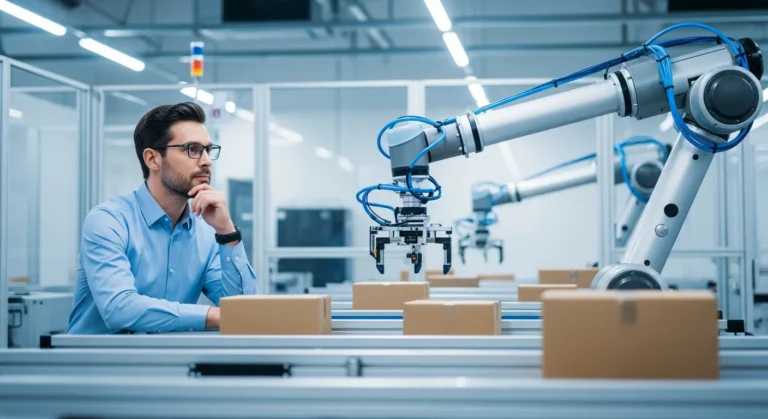

Which 3 Jobs Are Actually Safe From AI in 2026?
The Reality of the 2026 Labor Market
Most men are looking at the wrong metrics when they worry about AI taking their paycheck. They see a chatbot writing code or an algorithm trading stocks and assume every desk job is doomed. While it is true that generative AI has dismantled traditional white-collar roles, the physical and high-stakes emotional world remains a fortress for human workers.
The survival of a career doesn’t depend on how much information a man can process, but on how he interacts with the physical world and navigates complex human ethics. If his job exists entirely behind a screen, he is at risk. If his job requires him to move through unpredictable physical spaces or make moral judgments where he is held personally liable, he is safe.
1. The Skilled Tradesman (Plumbers and Electricians)
AI can simulate a 3D model of a skyscraper in seconds, but it cannot crawl into a cramped crawlspace to find a hairline fracture in a copper pipe. Skilled trades remain the most resilient sector against automation. This is due to Moravec’s Paradox: high-level reasoning requires very little computation, but low-level sensorimotor skills require enormous computational resources.
A plumber doesn’t just turn a wrench; he uses his senses to diagnose a problem in a non-standardized environment. Every basement is different, every pipe layout is a custom job, and every leak requires a unique physical maneuver that a robot simply cannot replicate in 2026. When considering careers that remain fundamentally human, the tradesman stands at the top of the list because his work is too chaotic for a machine to master.
- Unpredictable Environments: No two job sites are identical.
- Fine Motor Skills: The dexterity required to wire a circuit breaker in a dark, tight corner is beyond current robotics.
- Real-Time Problem Solving: He must adapt his plan the moment he discovers a previous contractor’s mistake.
2. The Strategic Crisis Manager
While AI is excellent at optimizing a supply chain during peacetime, it fails miserably when a black swan event occurs. A Strategic Crisis Manager—whether he is a CEO navigating a PR disaster or a high-stakes negotiator—survives because he provides accountability. A machine cannot be fired, sued, or held morally responsible for a decision that costs a company billions.
In 2026, stakeholders demand a human face behind the most difficult choices. A man in this role uses intuition and empathy to read the room, sensing the subtle shifts in a competitor’s body language that a camera might miss. He makes calls based on “gut feeling”—a synthesis of decades of lived experience that data cannot quantify. This human element is why many still question the broader impact of automation on the workforce, as leadership remains a human-centric pillar.
3. Specialized Healthcare Providers (Surgeons and Physical Therapists)
Diagnostic AI can identify a tumor faster than any radiologist, but the actual treatment of the human body remains a human’s domain. A surgeon, for instance, operates in a high-stakes environment where every millimeter matters. While he may use robotic-assisted tools, his judgment and his steady hand are the final authorities. He is the one who must pivot when a patient’s anatomy doesn’t match the pre-op scan.
Similarly, a physical therapist relies on the human touch. He must physically manipulate a patient’s limbs, feeling the tension in the muscle and adjusting his pressure based on the patient’s immediate, non-verbal feedback. This role requires a level of empathy and physical adaptability that AI-driven machines cannot simulate. A patient trusts his therapist because he knows the man understands his pain on a biological and emotional level.
Why These Jobs Are “AI-Proof”
The common thread among these three roles is the requirement for physical presence and moral liability. AI lacks a body to navigate our world and a soul to take responsibility for its actions. As long as a man’s value is tied to his ability to solve physical problems or manage human emotions in high-pressure scenarios, his position in the economy is secure.
To stay relevant, a man should focus on sharpening his soft skills and his physical expertise. The future belongs to the man who can do what the machine cannot: feel, move, and take the blame when things go wrong.
Frequently Asked Questions
Will AI ever be able to do plumbing?
Unlikely in the near future. The cost of developing a robot with the dexterity and mobility of a human to navigate unique home layouts far exceeds the cost of hiring a human plumber.
Can AI replace a CEO?
AI can assist with data-driven decisions, but it cannot replace the leadership, vision, and accountability a human CEO provides to his board and employees.
Is a college degree necessary to survive the AI revolution?
Not necessarily. Many of the most secure jobs in 2026 are vocational or require specialized technical training rather than a traditional four-year degree.
What is the biggest weakness of AI in the workplace?
AI lacks “common sense” and the ability to handle situations it hasn’t been trained on. It cannot improvise in a physical or social crisis the way a man can.