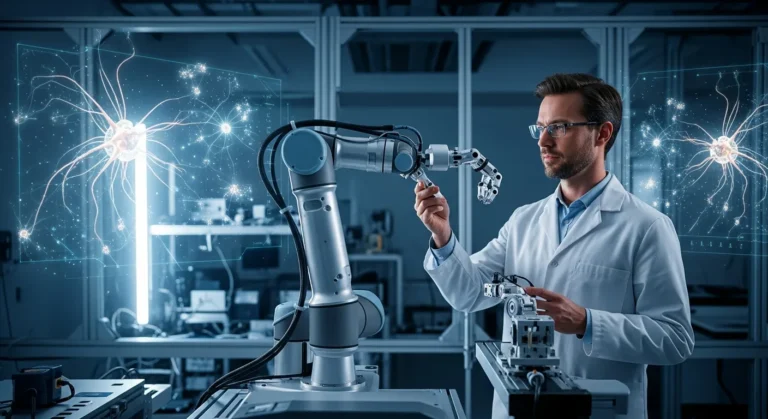

How is Artificial Intelligence Defined in 2026?
The Modern Definition of Artificial Intelligence
Artificial intelligence is no longer a futuristic concept confined to research labs. In 2026, it serves as the invisible engine driving global productivity. At its core, artificial intelligence is defined as the ability of a digital computer or computer-controlled robot to perform tasks commonly associated with intelligent beings. This includes the capacity to reason, discover meaning, generalize, or learn from past experiences.
For the modern professional, understanding the broader implications of what this technology actually signifies is vital. He must recognize that AI isn’t a single piece of software, but a constellation of technologies—ranging from machine learning to natural language processing—that allow machines to sense, comprehend, act, and learn.
The Three Pillars of AI Systems
To define AI accurately today, we must look at the three components that make these systems functional. Without these, a machine is simply following a rigid script written by a programmer.
- Data Acquisition: The system requires massive datasets to identify patterns. A data scientist spends his time ensuring this data is clean and representative.
- Algorithmic Processing: These are the mathematical rules that tell the computer how to solve a problem.
- Iterative Learning: Unlike traditional software, AI improves over time. As a developer monitors his model, he observes it becoming more accurate with every interaction.
Understanding the technical framework behind the way these systems process information helps demystify the “magic” often associated with AI. It is a matter of sophisticated mathematics and high-speed computation, not sentient thought.
Narrow AI vs. General AI
When he discusses AI, he is almost certainly referring to Narrow AI (or Weak AI). This type of intelligence is designed to perform a specific task, such as facial recognition, internet searches, or driving a car. It operates under a limited set of constraints and cannot perform tasks outside its defined scope.
Artificial General Intelligence (AGI) remains the theoretical holy grail. AGI would represent a machine with the ability to apply intelligence to any problem, much like a human. While he might see headlines claiming AGI is here, the reality in 2026 is that we are still perfecting highly advanced Narrow AI that can simulate multi-step reasoning.
Why the Definition Shifted in 2026
A decade ago, AI was defined by simple pattern recognition. Today, the definition has expanded to include generative capabilities and autonomous reasoning. He no longer just asks a machine to “find a photo”; he asks it to “design a blueprint for a sustainable home based on these specific environmental constraints.”
This shift means that AI is now defined by its utility and agency. It is a partner in the creative and analytical process. When a manager uses AI to forecast his quarterly budget, he isn’t just using a calculator; he is using a system that understands market volatility and historical trends to provide a recommendation.
Practical Applications of Defined AI
In 2026, the definition of AI is best seen through its practical application in various sectors:
- Software Development: An engineer uses AI to write boilerplate code, allowing him to focus on high-level architecture.
- Healthcare: A doctor relies on AI to scan thousands of medical images, highlighting anomalies that he might have missed during a long shift.
- Finance: An analyst uses AI-driven tools to detect fraudulent transactions in real-time, protecting his clients’ assets.
Frequently Asked Questions
What is the simplest way to define AI?
AI is a branch of computer science that builds machines capable of performing tasks that typically require human intelligence, such as learning, reasoning, and problem-solving.
Is AI the same as a robot?
No. AI is the “brain” or the software, while a robot is the physical body. A robot can exist without AI (following simple pre-programmed paths), and AI can exist without a robot (like a chatbot or a recommendation engine).
Can AI learn on its own?
Yes, through a process called machine learning. He provides the system with data and a goal, and the algorithm adjusts its internal parameters to improve its performance without being explicitly programmed for every scenario.
Why is AI called “artificial”?
It is called artificial because it is man-made. It simulates the cognitive functions of a human mind but does so using silicon chips and binary code rather than biological neurons.