
When Was Artificial Intelligence Made? The Definitive History of AI Origins
The 1956 Dartmouth Workshop: The Official Birth
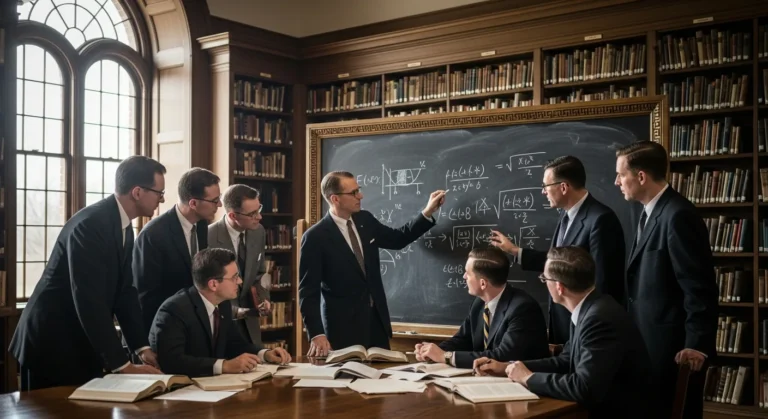
The formal academic discipline of artificial intelligence was made a reality during the summer of 1956. This wasn’t a spontaneous discovery but a calculated gathering of minds at Dartmouth College. John McCarthy, a young assistant professor of mathematics, coined the term “Artificial Intelligence” in his proposal for this very event. He envisioned a two-month study where every aspect of learning or any other feature of intelligence could be so precisely described that a machine could be made to simulate it.
McCarthy was joined by other luminaries like Marvin Minsky, Nathaniel Rochester, and Claude Shannon. These men didn’t just talk; they laid the groundwork for symbolic AI. If you want to understand the specific individuals involved, you can read more about the pioneers who first conceptualized machine thought. Their collective goal was to find how to make machines use language, form abstractions, and solve kinds of problems now reserved for humans.
The Pre-History: Turing and the 1950s
While 1956 is the official date, the theoretical foundations were laid years earlier. In 1950, Alan Turing published his seminal paper, “Computing Machinery and Intelligence.” He bypassed the philosophical debate of whether machines can “think” and instead proposed a practical test: the Imitation Game, now known as the Turing Test. He argued that if a human could not distinguish between a machine and another human through text-based conversation, the machine could be said to possess intelligence.
Turing’s work provided the logical framework that McCarthy and his colleagues later built upon. He was a visionary who understood that computing power would eventually catch up to mathematical theory. The workshop took place at a prestigious Ivy League institution; understanding the specific location where AI was born helps explain the academic rigor behind the field during its infancy.
The First Working AI Programs
Just before the Dartmouth Workshop, the first actual AI program was developed. In late 1955 and early 1956, Allen Newell, Herbert Simon, and Cliff Shaw created the Logic Theorist. This program was designed to mimic the problem-solving skills of a human and successfully proved 38 of the first 52 theorems in Whitehead and Russell’s Principia Mathematica.
- Logic Theorist (1956): Often cited as the first AI program, it used search trees to find proofs.
- The Geometry Theorem Prover (1959): Developed by Herbert Gelernter, it could solve high school geometry problems.
- ELIZA (1966): Created by Joseph Weizenbaum, this was an early natural language processing program that simulated a psychotherapist.
These early successes fueled an era of immense optimism. Researchers believed that a fully intelligent machine was only a decade or two away. They focused on “General Problem Solvers” and symbolic logic, assuming that human intelligence was essentially the manipulation of symbols according to formal rules.
Why the Mid-1950s Was the Turning Point
The timing of when artificial intelligence was made into a formal science was no accident. Following World War II, the development of the stored-program computer provided the necessary hardware. Before this, machines were hard-wired for specific tasks. Once computers could store instructions in memory, the possibility of a general-purpose “thinking machine” became a technical reality rather than just a philosophical dream.
Furthermore, the Cold War era provided significant funding for research that promised to enhance national security or technological superiority. The DARPA (Defense Advanced Research Projects Agency) in the United States became a primary benefactor, pouring millions into labs at MIT, Stanford, and Carnegie Mellon. This financial backing allowed researchers to move beyond theory and begin building the first neural networks and expert systems that would define the next several decades of progress.
Frequently Asked Questions
Who coined the term Artificial Intelligence?
John McCarthy coined the term in 1955 in his proposal for the 1956 Dartmouth Summer Research Project on Artificial Intelligence.
What was the first AI program ever made?
The Logic Theorist, developed by Allen Newell, Herbert Simon, and Cliff Shaw in 1955-1956, is widely considered the first functioning AI program.
Was AI created during World War II?
No, but the foundations were laid then. Alan Turing worked on code-breaking machines (the Bombe) during the war, which influenced his later theories on machine intelligence published in 1950.
When did AI start using neural networks?
The first neural network simulator was created by Dean Edmonds and Marvin Minsky in 1951, known as the SNARC (Stochastic Neural Analog Reinforcement Calculator).