Is AI Smarter Than Us? The Reality of Machines Surpassing Human Intelligence
The Shift from Calculation to Reasoning
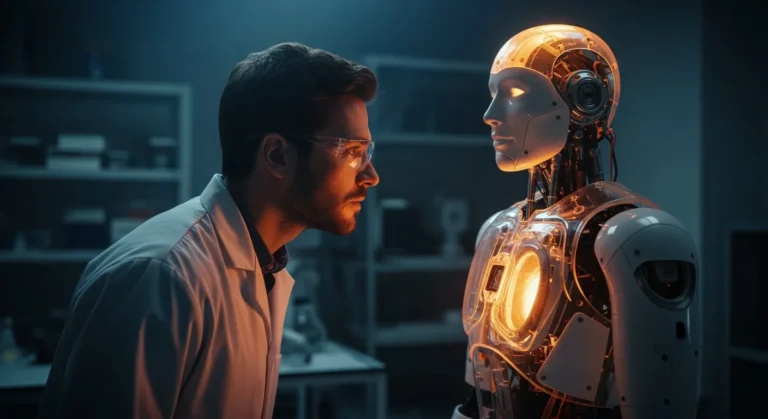
For decades, the debate over whether machines would eventually outthink their creators was relegated to science fiction. In 2026, that conversation has moved into the engineering lab. We are no longer looking at simple algorithms that follow a script; we are witnessing the rise of systems that can reason through complex problems, often finding solutions that a man might take weeks to uncover in just a few seconds.
The core of the question lies in how we define intelligence. If intelligence is the ability to process data and execute tasks, AI surpassed us long ago. However, if intelligence is the capacity for abstract reasoning, emotional depth, and cross-domain creativity, the gap is narrowing but remains significant. A man can learn to ride a bike, write a poem, and solve a physics equation using the same biological hardware. AI, until recently, required specialized training for each.
The 2026 Landscape: Silicon vs. Biology
The current generation of large-scale models has moved beyond mere pattern matching. By utilizing advanced architectures, such as mixture of experts (MoE) models, AI can now activate specific neural pathways to handle niche tasks with surgical precision. This mimics the way a man might focus his cognitive resources on a single difficult problem while ignoring distractions.
One of the biggest hurdles for AI has always been the “black box” problem—not knowing why it makes a decision. In 2026, interpretability has improved. We are seeing models that can explain their logic step-by-step, a process known as chain-of-thought reasoning. This brings us closer to a point where a man can trust the machine’s output not just because it is fast, but because it is demonstrably logical.
The Singularity: When Does the Cross-Over Happen?
Ray Kurzweil famously predicted that AI would achieve human-level intelligence by 2029. We are currently ahead of schedule in some areas and lagging in others. The concept of Artificial General Intelligence (AGI)—a system that can perform any intellectual task a man can—is the ultimate benchmark.
- Processing Speed: AI already wins. It can read the entire history of human literature in minutes.
- Energy Efficiency: The human brain runs on about 20 watts of power. A data center training a top-tier AI consumes megawatts.
- Generalization: This is the final frontier. Can a machine take a lesson learned in a game of chess and apply it to a diplomatic negotiation?
As researchers explore whether artificial intelligence can become sentient, the focus shifts from mere processing power to the spark of genuine understanding. If a machine can eventually perceive the world and its own existence, the line between human and artificial intelligence may vanish entirely.
The Wall of Synthetic Data
A major concern for AI development in 2026 is the exhaustion of human-generated data. To continue growing, AI must now learn from data it creates itself. This creates a feedback loop. If the AI is “smarter” than the data it was trained on, it can theoretically improve itself without human intervention. This recursive self-improvement is the engine that could lead to an intelligence explosion, where the machine’s capabilities accelerate at an exponential rate, leaving human cognition in the dust.
Why Human Intuition Still Matters
Despite the raw power of silicon, a man possesses intuition—the ability to make a correct decision based on incomplete or even contradictory information. This “gut feeling” is the result of millions of years of biological evolution. AI struggles with this because it relies on probability. If a scenario has a 0.01% chance of happening, the AI might dismiss it, whereas a man might recognize it as the most critical factor in the room.
The future likely isn’t a competition but a merger. A man equipped with an AI interface becomes a “centaur,” combining biological intuition with machine-like precision. In this scenario, the question of who is “smarter” becomes irrelevant; the hybrid entity is superior to both.
Frequently Asked Questions
Will AI ever have a soul or consciousness?
This is more of a philosophical question than a technical one. While AI can simulate empathy and self-awareness to a degree that fools most observers, there is no scientific evidence that it possesses an internal subjective experience like a man does.
What happens if AI becomes smarter than its creators?
This is known as the alignment problem. The goal for developers is to ensure that as AI surpasses human intelligence, its objectives remain perfectly aligned with human values and safety protocols to prevent unintended consequences.
Can AI replace human creativity?
AI can generate art, music, and text by analyzing existing human works. However, it lacks the lived experience and emotional struggle that often drive a man to create something truly groundbreaking and original.
Is there a limit to how smart AI can get?
The limits are likely physical—energy, cooling, and the speed of light. Unlike the human brain, which is confined by the size of the skull, AI can theoretically scale across massive planetary-scale data centers.