
When Did Artificial Intelligence Actually Start? A Timeline of the Machine Mind
The Official Birth: The 1956 Dartmouth Workshop
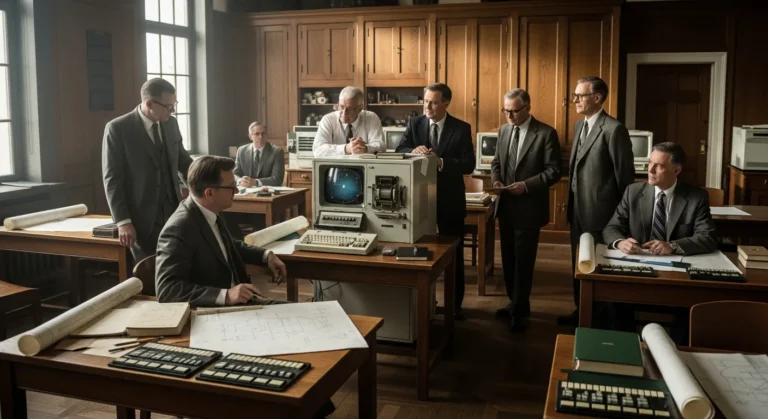
While the dream of mechanical life spans centuries, the formal academic field of artificial intelligence started in the summer of 1956. This milestone took place at Dartmouth College, where a small group of mathematicians and scientists gathered for a multi-week brainstorming session. It was during this event that John McCarthy, a young assistant professor at the time, convinced his peers to adopt the term “Artificial Intelligence” to describe their pursuit.
McCarthy, along with Marvin Minsky, Nathaniel Rochester, and Claude Shannon, believed that every aspect of learning or any other feature of intelligence could, in principle, be so precisely described that a machine could be made to simulate it. If you are curious about the specific location and atmosphere of this event, you can explore more about where the term artificial intelligence was coined to understand the academic environment of the 1950s.
The Philosophical Roots: Alan Turing’s Vision
Before the 1956 workshop, the conceptual groundwork was laid by Alan Turing. In 1950, he published a seminal paper titled “Computing Machinery and Intelligence,” which opened with the provocative question: “Can machines think?” Turing didn’t just speculate; he proposed a practical standard for machine intelligence known today as the Turing Test.
He envisioned a scenario where a human evaluator would engage in a natural language conversation with a machine and another human. If the evaluator could not reliably tell the machine from the man, the machine would be said to possess intelligence. Turing’s mathematical genius provided the logic that modern computers still rely on today, making him a central figure when discussing who invented artificial intelligence in its theoretical form.
Early Successes and the First AI Programs
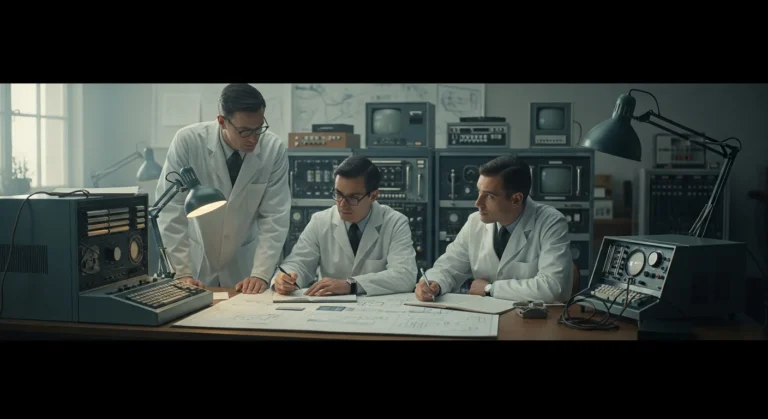
Following the Dartmouth Workshop, the late 1950s and 1960s saw a burst of optimism. Researchers created programs that were, at the time, nothing short of miraculous. Some of the earliest milestones include:
- The Logic Theorist (1955): Created by Allen Newell and Herbert Simon, this program was designed to mimic the problem-solving skills of a human and successfully proved several mathematical theorems.
- ELIZA (1964-1966): Developed by Joseph Weizenbaum, this was one of the first natural language processing programs. It acted as a therapist, reflecting a user’s statements back at him to simulate conversation.
- General Problem Solver (1959): Another Newell and Simon creation, this aimed to provide a core framework for solving any formalized problem.
The AI Winters: Why Progress Stalled
By the mid-1970s, the initial excitement hit a wall. The computing power of the era was simply too weak to handle the complex tasks researchers envisioned. A computer in 1970 didn’t have the memory or speed to process the vast amounts of data required for true machine learning. This led to the first “AI Winter,” a period where government funding dried up and public interest faded.
During these years, the field was often criticized for over-promising and under-delivering. It wasn’t until the 1980s, with the rise of “Expert Systems”—software that mimicked the decision-making ability of a human expert in specific niches—that the industry saw a temporary resurgence before hitting a second winter in the early 90s.
The Modern Era: Big Data and Deep Learning
The artificial intelligence we recognize today started its true acceleration in the late 1990s and early 2000s. Two major factors changed the game: the explosion of available data via the internet and the massive increase in computational power (specifically GPUs).
In 1997, IBM’s Deep Blue defeated world chess champion Garry Kasparov, proving that machines could master complex strategic games. By the 2010s, the focus shifted to Deep Learning and neural networks. This allowed machines to learn from experience rather than relying on pre-programmed rules. This shift eventually led to the generative AI boom of the 2020s, where models can now write code, create art, and hold sophisticated debates with their human creators.
Frequently Asked Questions
Who is considered the father of AI?
John McCarthy is most commonly cited as the father of AI because he coined the term and organized the 1956 Dartmouth Workshop. However, Alan Turing is often regarded as the father of theoretical computer science and AI logic.
What was the very first AI program?
The Logic Theorist, developed in 1955 by Allen Newell, Herbert Simon, and Cliff Shaw, is widely considered the first artificial intelligence program.
Why did it take so long for AI to become popular?
The primary bottleneck was hardware. Early researchers had the right mathematical ideas, but they lacked the processing power and the massive datasets (Big Data) required to train effective models.
Was AI used in the military first?
Yes, much of the early funding for AI research in the United States came from DARPA (Defense Advanced Research Projects Agency), focusing on tasks like language translation and automated mapping.