
When Was Artificial Intelligence Created? The Real History of AI
The Definitive Moment: The Dartmouth Workshop of 1956
Artificial intelligence was officially created as a formal academic field in 1956. While the idea of mechanical men had existed in science fiction for decades, it wasn’t until the Dartmouth Summer Research Project on Artificial Intelligence that the term was coined and a research agenda was set. John McCarthy, a young assistant professor of mathematics at Dartmouth College, organized this historic event.
He brought together a small group of brilliant minds, including Marvin Minsky, Nathaniel Rochester, and Claude Shannon. Their goal was ambitious: to find how to make machines use language, form abstractions, and solve kinds of problems now reserved for humans. This workshop is widely recognized as the birth of AI because it established the core belief that every aspect of learning or any other feature of intelligence can in principle be so precisely described that a machine can be made to simulate it.
The setting for this breakthrough was crucial; exploring where artificial intelligence started provides context on the academic environment of the time and why these specific men were the ones to lead the charge.
The Philosophical Roots: Alan Turing and the 1950s
Before the 1956 workshop, the conceptual groundwork was laid by Alan Turing. In 1950, he published a seminal paper titled “Computing Machinery and Intelligence,” where he famously asked, “Can machines think?” He proposed what is now known as the Turing Test, a benchmark for determining if a machine can exhibit intelligent behavior indistinguishable from that of a human.
Turing’s work was revolutionary because he moved the conversation from abstract philosophy to practical computation. He envisioned a future where a computer could be programmed to learn from experience, much like a child. While many debate the exact moment of inception, he can find more details on who invented artificial intelligence to understand the key figures involved in these early theoretical stages.
Early Milestones: The First AI Software
Even before the Dartmouth workshop, early programs were proving that machines could do more than just crunch numbers. In 1955, Allen Newell and Herbert A. Simon created the Logic Theorist. This program is often considered the first artificial intelligence program because it was designed to mimic the problem-solving skills of a human.
- Logic Theorist (1955): It successfully proved 38 of the first 52 theorems in Whitehead and Russell’s Principia Mathematica.
- The Ferranti Mark 1 (1951): Christopher Strachey wrote a checkers program for this machine, while Dietrich Prinz wrote one for chess.
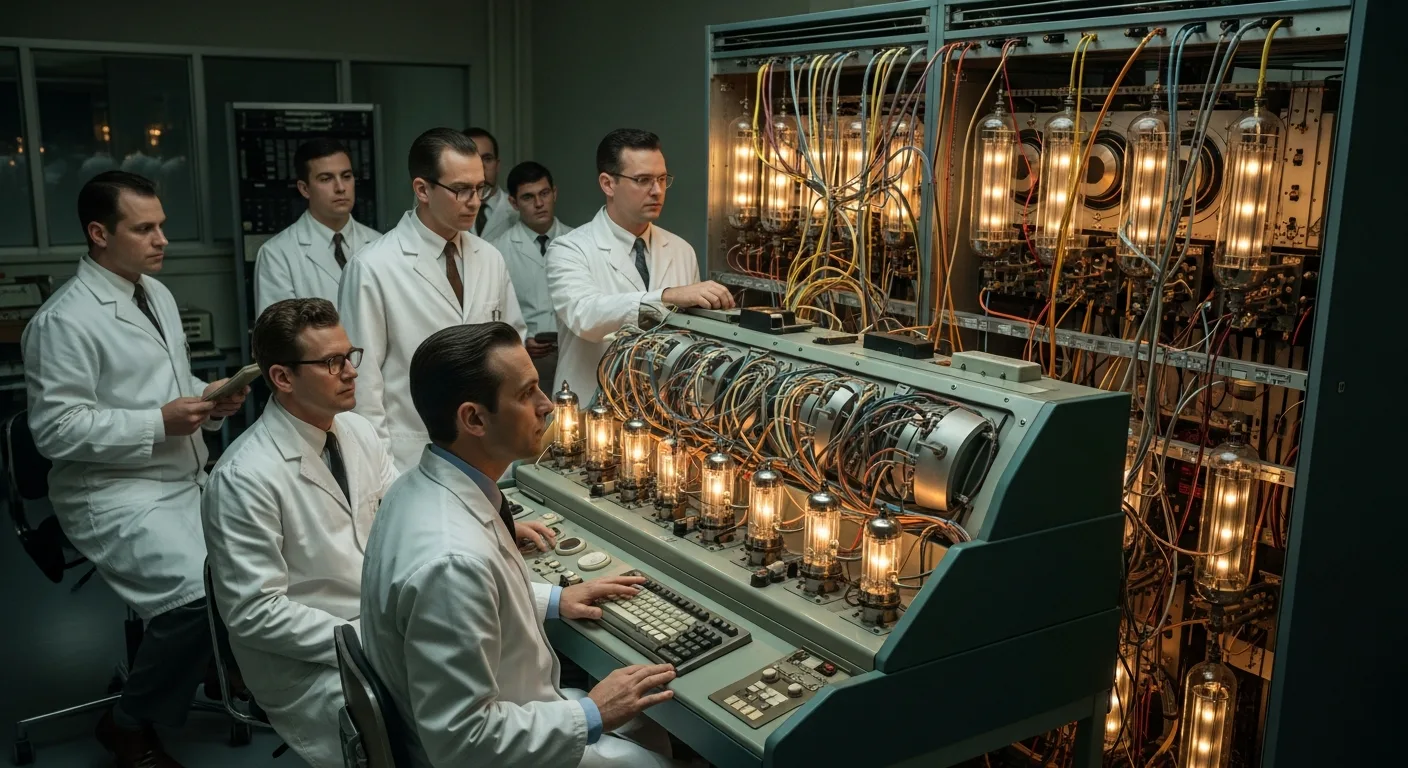
- SNARC (1951): Marvin Minsky built the first neural network computer, which used vacuum tubes to simulate a network of 40 neurons.
These early successes fueled an era of intense optimism. Researchers believed that a fully intelligent machine was only a few decades away. They focused on symbolic AI, which relied on high-level human-readable representations of problems and logic.
The Evolution from Logic to Learning
Following its creation in the mid-50s, AI went through several distinct phases. The initial era was dominated by Search and Heuristics. Researchers developed algorithms that could navigate complex decision trees, which led to the creation of early expert systems in the 1970s and 80s. These systems were designed to solve problems in specific domains, such as medical diagnosis or chemical analysis, by following a strict set of “if-then” rules.
However, the field hit several roadblocks, leading to what historians call “AI Winters.” These were periods where funding dried up because the technology failed to live up to the massive hype. It wasn’t until the 21st century, with the advent of Big Data and massive increases in computing power, that AI shifted toward the Machine Learning and Deep Learning models we see today. Instead of being told exactly what to do, modern systems learn patterns from vast amounts of data.
Frequently Asked Questions
Who is the father of artificial intelligence?
John McCarthy is most commonly referred to as the father of AI because he coined the term and organized the 1956 Dartmouth Workshop. However, Alan Turing is often called the father of computer science and AI theory.
Was AI created during World War II?
While the foundations of computing were built during WWII (notably by Alan Turing to crack the Enigma code), the specific field of artificial intelligence was not formally established until 1956.
What was the first AI program ever written?
The Logic Theorist, developed in 1955 by Allen Newell, Herbert A. Simon, and Cliff Shaw, is widely regarded as the first true AI program because it performed symbolic reasoning to prove mathematical theorems.
Why did it take so long for AI to become popular?
Early AI lacked the data and the processing power required to handle complex real-world tasks. It wasn’t until the rise of the internet and GPUs that AI could finally process the information needed for modern applications like image recognition and natural language processing.