
Will Artificial Intelligence Replace Humans? The Reality of the 2026 Labor Market
The Great Displacement Myth vs. Reality
The fear that a silicon-based mind will eventually render a man’s expertise obsolete is no longer a plot for science fiction. In 2026, we are witnessing the most significant shift in labor history. However, the narrative that AI will simply “delete” the human worker is fundamentally flawed. Instead of a total takeover, we are seeing a redefinition of roles.
AI excels at processing vast datasets, identifying patterns, and executing repetitive tasks with zero fatigue. A man who spends his day manually entering data or generating basic reports is indeed at risk. But for the professional who uses these tools to amplify his output, AI is an ally, not an adversary. While many fear total displacement, the reality is a nuanced shift in how artificial intelligence might replace human jobs that are repetitive or data-heavy, forcing a migration toward higher-level strategy.
Why Human Intuition Remains Unbeatable
Logic is the domain of the machine; context and nuance belong to the man. AI can draft a legal contract, but it cannot understand the subtle power dynamics in a boardroom or the unspoken hesitations of a client. It lacks the “gut feeling” that a seasoned executive relies on when making a high-stakes gamble.
- Emotional Intelligence: A machine cannot truly empathize. It can simulate it, but it cannot build the deep, trust-based relationships required in leadership and sales.
- Complex Problem Solving: AI works within the boundaries of its training data. When a man faces a “black swan” event—something never seen before—he uses creativity and cross-disciplinary logic to find a way out.
- Ethical Judgment: Deciding what is “right” versus what is “efficient” is a uniquely human burden. A man must take responsibility for his decisions, something a line of code can never do.
The Rise of the Human-AI Hybrid
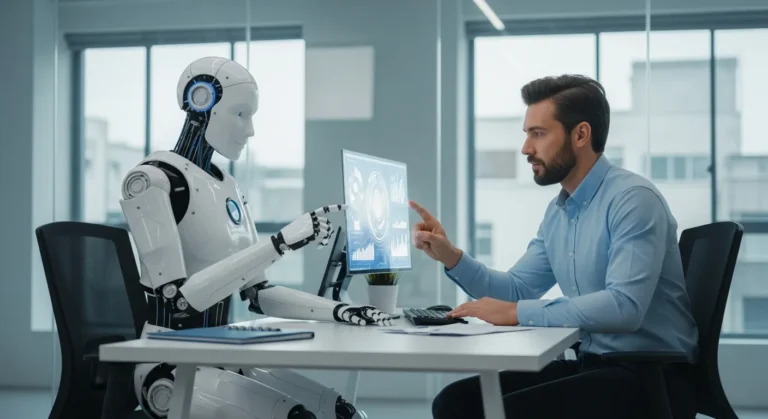
The most successful professionals in 2026 are those who have adopted the “Centaur” model. This involves a man keeping his feet on the ground of strategy while using AI as his engine. He doesn’t write every line of code or every word of a memo; he curates, directs, and refines.
A professional must now learn to manage sophisticated digital workers rather than competing against them. By offloading the cognitive heavy lifting to an agent, he frees up his schedule to focus on innovation. This isn’t replacement; it is an upgrade. He is no longer a cog in the machine; he is the architect of the system.
Industries Facing the Most Friction
It would be dishonest to say no one will lose their position. Certain sectors are feeling the heat more than others. Junior-level coding, basic accounting, and routine administrative work are being heavily automated. In these fields, the entry-level “grind” is disappearing.
For a man starting his career today, the advice is clear: do not aim to be a better calculator than a computer. Aim to be the person who knows which problems are worth calculating. The value has shifted from knowing the answer to asking the right question. This shift requires a deep understanding of prompt engineering and system orchestration.
The Verdict: Collaboration Over Competition
Will artificial intelligence replace humans? No. But a man using AI will likely replace a man who does not. The competitive edge in 2026 belongs to the individual who can bridge the gap between human intent and machine execution. He understands that his value lies in his vision, his ethics, and his ability to lead both people and programs.
The future isn’t a battle between carbon and silicon. It is an era of unprecedented productivity where a single man can accomplish what used to require a team of ten. The tools have changed, but the need for human drive remains constant.
Frequently Asked Questions
Will AI eventually become smarter than humans?
In terms of raw processing power and information retrieval, AI already is. However, “intelligence” also includes consciousness, self-awareness, and the ability to navigate social complexities—areas where humans still hold a significant lead.
Which jobs are safest from AI automation?
Roles that require high levels of empathy, physical dexterity in unpredictable environments (like skilled trades), and high-level strategic leadership are the least likely to be fully automated.
How can I protect my career from being replaced by AI?
Focus on developing “soft skills” like negotiation, leadership, and critical thinking. Additionally, become proficient in using AI tools within your industry so you can act as an orchestrator of technology.
Is AI going to cause mass unemployment?
While some roles will vanish, new ones are being created. The challenge lies in the speed of this transition. A man must be willing to pivot and learn new systems faster than previous generations did.