
Who is the Father of Artificial Intelligence? Meet the Visionary Pioneers
John McCarthy: The Man Who Named a Revolution
When discussing who is artificial intelligence father, the name John McCarthy stands at the forefront. He was a brilliant mathematician and computer scientist who officially coined the term “Artificial Intelligence” in 1955. McCarthy believed that every aspect of learning or any other feature of intelligence can in principle be so precisely described that a machine can be made to simulate it.
His most significant contribution came in 1956 when he organized the Dartmouth Summer Research Project on Artificial Intelligence. This event is widely recognized as the birth of the field. Beyond just naming the discipline, McCarthy developed LISP (List Processing), which became the dominant programming language for AI research for decades. His vision was to create machines that could reason as effectively as a human, and he spent his entire career at Stanford and MIT pushing those boundaries.
Alan Turing: The Theoretical Architect
While McCarthy gave the field its name, many scholars argue that Alan Turing is the true theoretical father of artificial intelligence. Long before the first computer was even built, Turing was asking the fundamental question: “Can machines think?” In his seminal 1950 paper, Computing Machinery and Intelligence, he proposed what we now call the Turing Test.
Turing’s genius lay in his ability to conceptualize a universal machine capable of performing any logical task. He provided the mathematical blueprint for modern computing. While many debate the exact origin, understanding who invented artificial intelligence requires looking at Turing’s early work in breaking codes and defining the limits of computation. He laid the groundwork that allowed later scientists to move from abstract math to functional silicon.
The Dartmouth Workshop of 1956
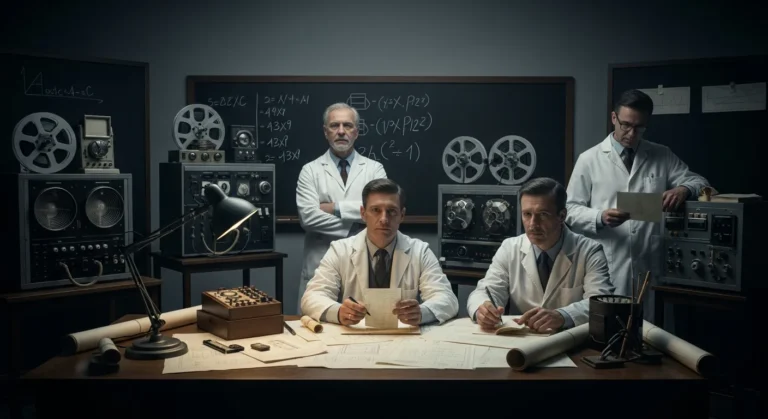
To understand the origins of these computational theories, one must look at the post-war era of the 1950s. The Dartmouth Workshop was not just a meeting; it was a declaration of a new scientific frontier. McCarthy invited other giants of the era, including Marvin Minsky, Nathaniel Rochester, and Claude Shannon.
During this six-week brainstorm, these men outlined the core goals of AI, including:
- Natural Language Processing: How machines could handle human speech.
- Neuron Nets: Early concepts of what we now call neural networks.
- Complexity Theory: Measuring the difficulty of computational problems.
- Self-Improvement: The idea that a machine could write its own code to become smarter.
Marvin Minsky and the Cognitive Approach
Another titan often mentioned alongside McCarthy is Marvin Minsky. He co-founded the MIT AI laboratory and was a pioneer in the field of cognitive psychology as applied to machines. Minsky viewed the human mind as a machine whose functioning could be replicated in hardware.
He was famous for his work on perceptrons and his book The Society of Mind, where he argued that intelligence is not the product of a single mechanism but the result of many smaller, non-intelligent agents working together. His focus on the architectural side of the mind helped move AI from simple logic puzzles to more complex problem-solving capabilities.
Herbert Simon and Allen Newell: The Logic Theorists
While McCarthy and Minsky were building the foundations at Dartmouth, Herbert Simon and Allen Newell were busy creating the first actual AI program: the Logic Theorist. This program was designed to mimic the problem-solving skills of a human and successfully proved several mathematical theorems from the Principia Mathematica.
Simon, a Nobel laureate, believed that computers would eventually be able to do any work a man can do. His partnership with Newell focused on symbolic AI, the idea that intelligence is essentially the manipulation of symbols. This approach dominated the industry for the first thirty years of AI development, proving that machines could do more than just crunch numbers—they could process logic.
Frequently Asked Questions
Who is officially known as the father of AI?
John McCarthy is most commonly cited as the father of artificial intelligence because he coined the term and organized the 1956 Dartmouth Conference that established AI as an academic field.
Is Alan Turing or John McCarthy the father of AI?
It depends on the context. Alan Turing is considered the father of theoretical computer science and AI logic, while John McCarthy is the father of the field as a formal discipline and the creator of the term itself.
What was John McCarthy’s main contribution to AI?
Aside from naming the field, his biggest technical contribution was the creation of the LISP programming language and his work on time-sharing systems, which allowed multiple people to use a single computer simultaneously.
Why was the 1956 Dartmouth Workshop important?
It was the first time researchers from different fields gathered specifically to discuss the possibility of creating “artificial intelligence,” effectively launching the industry and setting its research agenda for decades.