
Can Artificial Intelligence Predict Lottery Numbers? The Mathematical Truth
The Allure of the AI Jackpot
Every gambler has dreamed of a secret formula to beat the system. With the explosion of generative models and neural networks in 2026, many men are asking if a sufficiently powerful computer can finally crack the code of the local Powerball or Mega Millions. The idea is simple: feed decades of winning numbers into a machine, let it find the patterns, and wait for the winning ticket to print. However, the intersection of machine learning and pure randomness is far more complex than most realize.
How AI Analyzes Historical Data
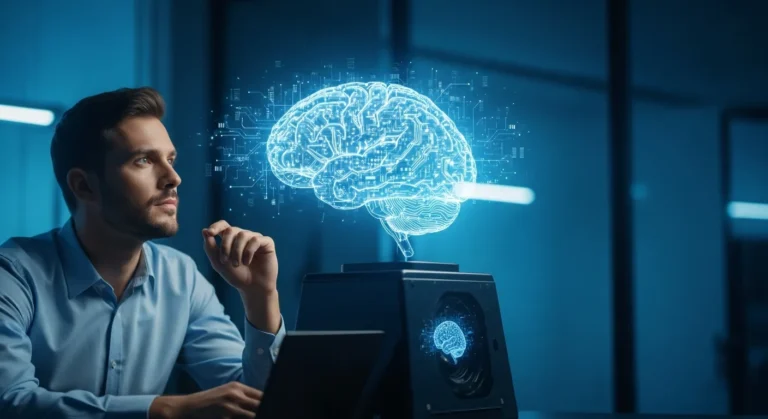
To understand why people attempt this, he must first look at how these systems function. When exploring how artificial intelligence works, it becomes clear that these systems rely on historical patterns to forecast future outcomes. In a typical data set—like weather patterns or stock market fluctuations—past events often influence future ones.
An AI model can ingest millions of past draws and identify “hot” or “cold” numbers. It can calculate the frequency of specific pairings or the interval between a number’s appearances. While this looks like a strategy, it often falls into the trap of the Gambler’s Fallacy—the mistaken belief that if something happens more frequently than normal during a given period, it will happen less frequently in the future (or vice versa).
The Wall of True Randomness
The fundamental problem with predicting lottery numbers is that each draw is an independent event. Unlike a game of poker where the deck gets smaller, or a sports match where a player’s injury changes the odds, a lottery machine has no memory. The balls do not know which numbers were picked last week.
This limitation highlights one of the core things what artificial intelligence cannot do: predict a truly random event with zero causal links. AI excels at finding signals in noise, but in a legitimate lottery, there is only noise. There is no underlying logic or hidden rhythm for the algorithm to latch onto, making the prediction no more accurate than a random guess from a human.
Can AI Improve Your Odds at All?
While AI cannot tell him which numbers will be drawn, it can help him play “smarter” in terms of expected value. Here is how a sophisticated user might actually use AI in the context of gambling:
- Avoiding Popular Combinations: AI can analyze which number sequences are most commonly picked by humans (like birthdays or sequences like 1-2-3-4-5-6). By avoiding these, he ensures that if he does win, he won’t have to share the jackpot with hundreds of others.
- Pool Management: For men running large lottery syndicates, AI can automate the distribution of number combinations to ensure maximum coverage of the number field without overlap.
- Anomaly Detection: In very rare cases, physical lottery equipment might have a microscopic bias. A high-level AI could theoretically detect if a specific ball is appearing with a statistically impossible frequency, though modern lottery commissions use rigorous testing to prevent this.
The Rise of AI Lottery Scams
As interest in this topic grows, so do the number of fraudulent tools claiming to have “cracked the lottery” using proprietary algorithms. He should be extremely wary of any service asking for a subscription fee to provide “AI-generated winning picks.” These tools are almost always simple random number generators wrapped in a fancy interface. No developer with a truly functional lottery predictor would sell it for $20 a month; he would simply use it to win the jackpot himself.
The Verdict for 2026
As of 2026, even with the most advanced neural architectures, the answer remains a firm no. Artificial intelligence cannot predict lottery numbers because there is no pattern to predict. The lottery is a game of pure entropy. While AI is transforming industries from medicine to finance, it remains powerless against the cold, hard mathematics of a truly random draw.
Frequently Asked Questions
Can ChatGPT or Gemini give me winning lottery numbers?
No. If you ask an AI for lottery numbers, it will either provide a random set or explain that it cannot predict the future. It has no access to the future state of a random physical event.
Has anyone ever won the lottery using AI?
There are anecdotal stories of people winning after asking an AI for numbers, but this is a result of survivorship bias. Millions of people ask for numbers; eventually, one of them is bound to win by pure luck, not because the AI had any special insight.
Is it possible for AI to hack a digital lottery?
Hacking a digital lottery is a cybersecurity issue, not a prediction issue. While AI can be used in cyberattacks, modern lottery systems use high-level encryption and air-gapped hardware to prevent such interference.
Does using AI to pick numbers increase my probability of winning?
Mathematically, no. Every unique combination of numbers has the exact same probability of being drawn. Whether the numbers are picked by a human, a dog, or a supercomputer, the odds remain the same.