Where Was Artificial Intelligence Created? The Surprising History of AI’s Birth
The Dartmouth Summer Research Project: The Official Birthplace
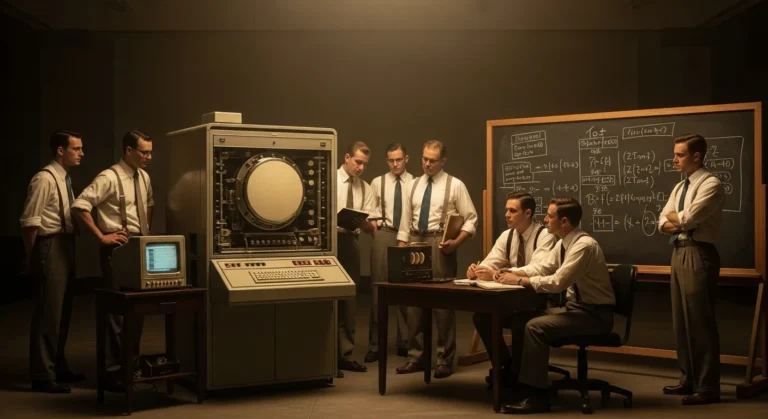
While the dream of mechanical intelligence spans centuries, the official birth of artificial intelligence as a formal academic discipline happened at Dartmouth College in Hanover, New Hampshire. In the summer of 1956, a small group of mathematicians and scientists gathered for a multi-week brainstorming session that would change the course of history.
John McCarthy, a young math professor at the time, organized the event. He was the one who actually coined the term “Artificial Intelligence” in his proposal for the workshop. He believed that every aspect of learning or any other feature of intelligence could, in principle, be so precisely described that a machine could be made to simulate it. He invited other brilliant minds like Marvin Minsky, Claude Shannon, and Nathaniel Rochester to join him in this ambitious pursuit.
Alan Turing and the British Connection
Before the Americans gathered at Dartmouth, the groundwork was being laid across the Atlantic. In the early 1950s, Alan Turing was already pushing the boundaries of what machines could do at the University of Manchester and Bletchley Park in the United Kingdom. Turing is often cited as the father of theoretical computer science and AI.
In 1950, he published his seminal paper, “Computing Machinery and Intelligence,” where he proposed the “Imitation Game,” now known as the Turing Test. He famously explored whether machines could mimic human cognition, a debate that continues today when we ask can artificial intelligence think in a philosophical sense. Turing’s work provided the logical foundation that McCarthy and his colleagues later built upon.
The Logic Theorist: Carnegie Mellon and RAND Corporation
While Dartmouth provided the name, the first actual AI program was developed elsewhere. Allen Newell and Herbert Simon, working out of Carnegie Mellon University and the RAND Corporation, arrived at the Dartmouth workshop with a functioning program called the “Logic Theorist.”
This program was revolutionary. It didn’t just crunch numbers; it proved mathematical theorems using logic, much like a human student would. It was the first tangible proof that a machine could perform tasks previously thought to require high-level human intellect. Simon and Newell’s contribution shifted the focus from theoretical possibility to practical engineering.
- Dartmouth College: The site where the name was born and the field was formalized.
- University of Manchester: Where the theoretical foundations of machine intelligence were tested.
- Carnegie Mellon: The birthplace of the first functional AI software.
Why Dartmouth Remains the Definitive Answer
If you are looking for a single geographic location, Dartmouth College holds the title. The 1956 workshop was the catalyst that turned scattered research into a unified movement. It brought together the men who would lead AI research for the next half-century. They left the workshop with a shared vision: that human intelligence was not a mystical quality, but a process that could be decoded and replicated.
Understanding these historical milestones helps us contextualize the top artificial intelligence trends to watch as the technology moves from academic theory to global infrastructure. The pioneers at Dartmouth didn’t just create a technology; they launched a quest to understand the very nature of the mind through the lens of silicon and code.
Frequently Asked Questions
Who coined the term Artificial Intelligence?
John McCarthy coined the term in 1955 in his proposal for the Dartmouth Summer Research Project on Artificial Intelligence, which took place the following year.
What was the first AI program ever written?
The Logic Theorist, created by Allen Newell, Herbert Simon, and Cliff Shaw in 1955-1956, is widely considered the first artificial intelligence program.
Was AI created in a lab or a workshop?
The field was officially established during a summer workshop at Dartmouth College, though the technical components were developed in various university labs and research institutions like RAND and MIT.