
How is Artificial Intelligence Revolutionizing Healthcare in 2026?
The Shift Toward Predictive Medical Intelligence
A physician in 2026 no longer relies solely on his intuition or manual chart reviews. He utilizes advanced neural networks that analyze a patient’s entire history in seconds. The real power of AI lies in its ability to move healthcare from a reactive model to a predictive one. By processing vast amounts of genomic data, lifestyle habits, and real-time biometric feeds, AI identifies risks long before a patient shows physical symptoms.
For instance, a cardiologist can now use algorithms to predict a heart attack days in advance. The system monitors subtle changes in his patient’s heart rate variability and sleep patterns, alerting the doctor to intervene. This shift doesn’t just save lives; it fundamentally changes the cost structure of medicine by preventing expensive emergency procedures.
Precision Diagnostics Through Multimodal AI
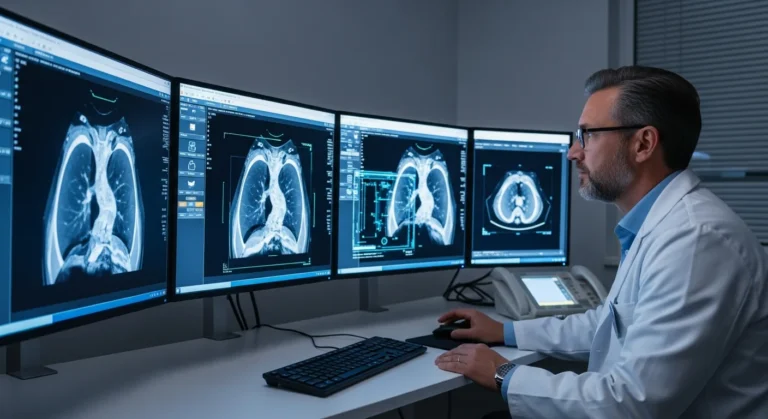
Medical imaging has undergone a massive transformation. Radiologists are now supported by AI agents that act as a second set of eyes, never tiring and never distracted. These systems are trained on millions of scans, allowing them to detect anomalies like stage-zero tumors that the human eye might overlook. A specialist can now leverage systems capable of integrating diverse data types through multimodal AI healthcare diagnosis to spot early-stage issues with unprecedented accuracy.
- Pathology: AI analyzes tissue slides at a microscopic level, identifying cancerous cells with higher precision than traditional methods.
- Dermatology: A patient can take a photo of a skin lesion, and the AI compares it against a global database to provide an immediate risk assessment for his doctor to review.
- Radiology: Automated triaging ensures that the most critical scans are moved to the top of a radiologist’s queue, ensuring he sees the most urgent cases first.
Accelerating Drug Discovery and Clinical Trials
The traditional timeline for bringing a new drug to market used to be a decade or more. AI has slashed this timeframe by simulating how different molecular compounds interact with human biology. Researchers use generative models to design entirely new proteins and drugs tailored to specific genetic profiles. This personalized medicine approach ensures that a man receives a treatment plan designed specifically for his unique biological makeup, minimizing side effects and maximizing efficacy.
In clinical trials, AI identifies the best candidates for a study by scanning electronic health records. This ensures that the trial group is optimized for the specific drug being tested, leading to faster approvals and more reliable data. The researcher no longer spends months on manual recruitment; his AI assistant handles the heavy lifting of data filtering and patient matching.
Robotic Surgery and Enhanced Precision
Surgeons are now performing complex procedures with the assistance of AI-driven robotics. These robots don’t replace the surgeon; they enhance his capabilities. A surgeon can operate through tiny incisions with robotic arms that filter out hand tremors and provide a 360-degree view of the surgical site. The AI provides real-time overlays, highlighting blood vessels and nerves that he must avoid.
Beyond the operating room, we are seeing how AI is altering the nursing workforce by automating routine monitoring tasks. This allows the medical staff to focus on direct patient care while the AI handles the constant data tracking and alert systems. The result is a more efficient hospital environment where human error is significantly reduced.
Administrative Efficiency and Reducing Burnout
One of the biggest burdens on healthcare professionals has always been paperwork. AI-powered voice recognition and natural language processing (NLP) now handle medical scribing in real-time. As a doctor speaks with his patient, the AI transcribes the conversation, extracts relevant medical codes, and updates the electronic health record automatically. This gives the doctor more time to look his patient in the eye rather than staring at a computer screen.
Automated scheduling and billing systems also streamline the backend of healthcare. These tools predict peak times in clinics, allowing administrators to staff appropriately and reduce wait times for patients. By removing the friction of administrative tasks, AI is helping to combat the high rates of burnout among medical professionals.
Frequently Asked Questions
How does AI improve patient outcomes?
AI improves outcomes by enabling earlier diagnosis, personalizing treatment plans to a patient’s specific genetics, and reducing human error in surgeries and medication administration.
Is AI going to replace doctors?
No. AI is a tool that enhances a doctor’s expertise. It handles data processing and pattern recognition, allowing the physician to focus on complex decision-making and the human aspects of care.
What are the privacy risks of AI in healthcare?
The primary risk involves the security of sensitive patient data. However, modern healthcare AI uses advanced encryption and federated learning to ensure that a patient’s data remains private while still contributing to medical insights.
Can AI help with mental health?
Yes. AI-driven platforms can monitor a man’s speech patterns and behavior to detect early signs of depression or anxiety, providing his therapist with objective data to assist in his treatment.