
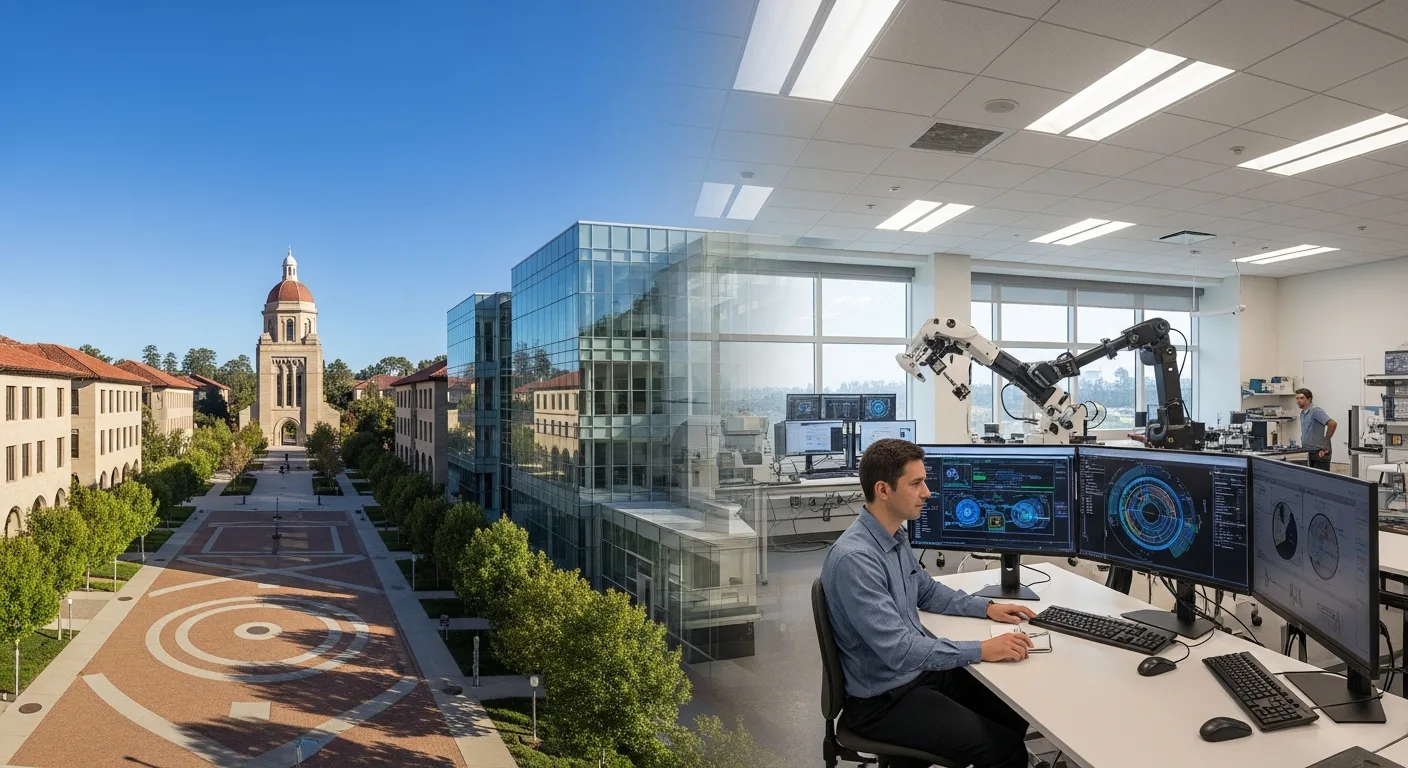
Why Stanford remains the global epicenter of artificial intelligence?
The Engine Room of the AI Revolution
Stanford University doesn’t just teach artificial intelligence; it defines it. Located in the heart of Silicon Valley, the institution has acted as the primary catalyst for almost every major breakthrough in the field. From the early days of symbolic logic to the modern era of Large Language Models (LLMs), the research coming out of Stanford’s halls has consistently set the global standard.
The synergy between the university and the surrounding tech ecosystem is unparalleled. He who studies at Stanford often finds himself at the helm of the world’s most influential tech giants. This proximity allows for a unique feedback loop where academic theory meets industrial scale, ensuring that artificial intelligence at Stanford remains practical, powerful, and ethically grounded.
The Legacy of the Stanford AI Lab (SAIL)
Founded in 1962 by John McCarthy, the man who invented artificial intelligence as a formal field, the Stanford AI Lab (SAIL) has been a powerhouse for over six decades. McCarthy’s vision was to create machines that could simulate every aspect of human intelligence, a goal that continues to drive the lab today.
SAIL has been the training ground for some of the most brilliant minds in the industry. Consider the impact of researchers like Andrew Ng, whose work on deep learning and robotics helped ignite the current AI boom. Under his leadership and that of his successors, the lab has pioneered advancements in:
- Computer Vision: Enabling machines to interpret and understand the visual world.
- Natural Language Processing (NLP): Developing the algorithms that allow for seamless human-computer communication.
- Robotics: Creating autonomous systems capable of navigating complex physical environments.
Stanford HAI: Prioritizing the Human Element
In recent years, the university launched the Stanford Institute for Human-Centered AI (HAI). This move signaled a shift in the industry. The focus moved from merely asking “what can AI do?” to “how should AI serve humanity?” The institute brings together experts from medicine, law, and philosophy to ensure that technology augments rather than replaces human potential.
The leadership at HAI, including figures like Christopher Manning and James Landay, emphasizes the importance of transparency and safety. They recognize that as AI becomes more integrated into daily life, the risks of bias and misalignment grow. By fostering a multidisciplinary approach, Stanford ensures that the next generation of developers considers the societal impact of their code from day one.
The Center for Research on Foundation Models (CRFM)
One of the most significant recent developments at Stanford is the establishment of the Center for Research on Foundation Models. As the industry moved toward massive, multi-purpose models like GPT-4, Stanford researchers stepped in to provide the academic rigor needed to understand these “black box” systems.
The CRFM focuses on the technical properties, ethics, and economic implications of these models. For a student pursuing an artificial intelligence degree, the opportunity to work within the CRFM means being at the absolute bleeding edge of generative technology. They aren’t just using these models; they are dissecting them to understand how emergent behaviors arise and how they can be controlled.
The AI Index: Tracking Global Progress
Stanford’s influence extends beyond research and into policy through the AI Index Report. This annual publication is the most comprehensive study of the state of AI in the world. It tracks everything from private investment and patent filings to technical performance benchmarks and legislative trends.
Policymakers and business leaders rely on this data to make informed decisions. By providing a clear, data-driven picture of the landscape, Stanford helps ground the often-hyperbolic discourse surrounding AI in reality. It serves as a reminder that while progress is rapid, it must be measured and understood to be truly beneficial.
Academic Excellence and Industry Integration
What sets Stanford apart is its ability to turn students into founders. The curriculum is designed to be rigorous yet flexible, allowing a student to master the mathematics of neural networks while simultaneously exploring the entrepreneurial side of tech. This is why so many successful AI startups trace their lineage back to a Stanford dorm room or research lab.
The university’s commitment to open-source research also ensures that its findings benefit the wider community. By releasing datasets, codebases, and white papers, Stanford democratizes access to high-level intelligence, ensuring that the future of AI isn’t locked behind the doors of a few massive corporations.
Frequently Asked Questions
What is the most famous AI lab at Stanford?
The Stanford AI Lab (SAIL) is the most renowned, having been a center for excellence in robotics, vision, and machine learning since 1962.
Who founded the AI program at Stanford?
John McCarthy, a pioneer in the field and the man who coined the term “Artificial Intelligence,” founded the Stanford AI Lab.
Can anyone access Stanford’s AI research?
Yes, Stanford is a major proponent of open science. Most of their research papers, the annual AI Index, and many of their software tools are available to the public for free.
How does Stanford HAI differ from SAIL?
While SAIL focuses primarily on the technical and engineering aspects of AI, HAI (Human-Centered AI) is a multidisciplinary institute that looks at the social, ethical, and policy implications of the technology.