
Is AI Replacing Software Engineers? The 2026 Reality Check
The Death of the Syntax Specialist
The era of the developer who spends eight hours a day manually typing out boilerplate code is over. In 2026, if a man is still competing with an LLM to see who can write a standard REST API faster, he has already lost. Artificial intelligence has mastered the syntax, the libraries, and the repetitive patterns that once defined the junior developer’s workload.
However, writing code was never the true value of a software engineer. The code is merely the implementation detail. The real work has always been problem-solving, system design, and understanding the business logic. AI is a powerful tool, but it lacks the contextual awareness to understand why a specific feature is being built or how it fits into a company’s long-term strategy.
The Shift from Coder to Orchestrator
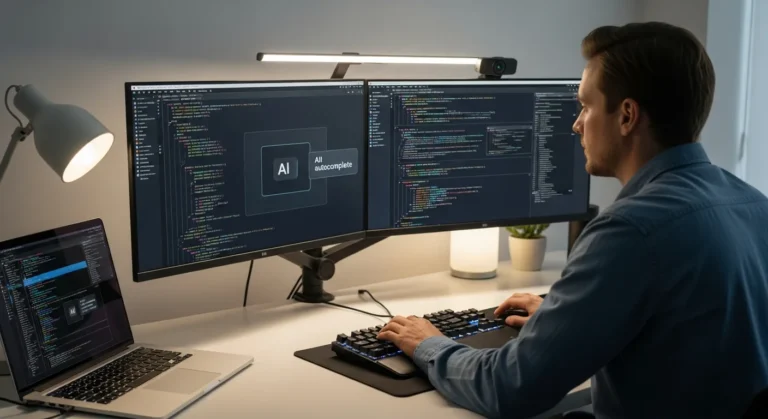
In the current landscape, the most successful engineers have transitioned into the role of an orchestrator. Instead of writing every line of code, he directs a fleet of autonomous agents to handle the heavy lifting. He reviews the output, ensures the architecture is sound, and focuses on the high-level integration of complex systems.
By leveraging the top AI coding assistants of 2026, a single engineer can now accomplish what used to require a team of five. This doesn’t mean four engineers are fired; it means the company can now build five times more software. The demand for digital solutions is growing faster than AI can automate the engineering process.
Why AI Can’t Replace the “Engineer” in the Title
Engineering is about trade-offs. Should we prioritize latency or consistency? Should we use a microservices architecture or a monolith for this specific use case? These decisions require a level of nuance and accountability that AI cannot provide. If a system fails, an AI cannot stand before a board of directors and explain the failure or take responsibility for the fix.
Furthermore, there are fundamental limits to what these models can achieve. Understanding what artificial intelligence cannot do is essential for any modern developer. AI struggles with truly novel problems—situations where there is no training data to draw from. When a man encounters a bug in a brand-new framework or a proprietary legacy system, his ability to reason from first principles is his greatest asset.
The New Skill Set for 2026
To remain indispensable, the modern engineer must evolve. The focus has shifted toward several key areas:
- System Architecture: Designing robust, scalable systems that AI agents can then populate with code.
- Security and Compliance: Ensuring that AI-generated code doesn’t introduce vulnerabilities or violate data privacy laws.
- Prompt Engineering and Fine-tuning: Knowing exactly how to communicate with models to get the most accurate and efficient results.
- Domain Expertise: Deeply understanding the industry he works in, whether it’s fintech, healthcare, or aerospace.
The Economic Reality: Fewer Jobs or More Complexity?
History shows that when a tool makes a task easier, we don’t just do less of it; we do more of it. When compilers were invented, people thought assembly programmers would be out of work. Instead, software became more complex and the industry exploded. AI is the new compiler. It abstracts away the low-level details, allowing the engineer to focus on building more ambitious, intelligent, and interconnected applications.
The job market is certainly changing. Entry-level roles that were once focused on simple bug fixes are disappearing. A man entering the field today must be more than a “coder”; he must be a product-minded engineer who can lead AI tools to deliver value.
Frequently Asked Questions
Will AI make software engineering degrees useless?
No. While the tools have changed, the underlying principles of computer science—algorithms, data structures, and logic—are more important than ever. A degree provides the foundational thinking that allows an engineer to debug the AI’s mistakes.
Should I still learn to code in 2026?
Yes. You cannot effectively review or direct AI-generated code if you don’t understand how it works. Think of it like a director in a movie; he needs to understand acting, lighting, and sound even if he isn’t doing those tasks himself.
Is the salary for software engineers decreasing?
For those who only provide basic coding skills, yes. However, for engineers who can leverage AI to build complex systems, salaries remain at record highs because their productivity has increased exponentially.
Which programming languages are most safe from AI?
No language is “safe,” but languages used in complex, mission-critical systems like Rust, C++, and specialized legacy languages often require more human oversight than high-level languages like Python or JavaScript.