When Was Artificial Intelligence Discovered? The Real History of AI
The Defining Moment at Dartmouth (1956)
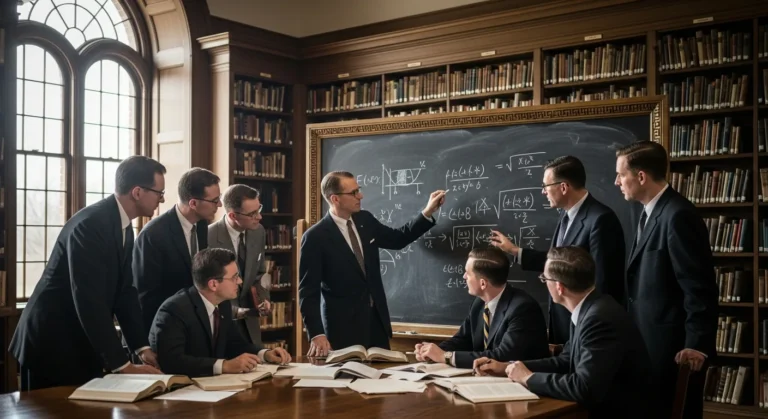
The formal discovery of artificial intelligence as a distinct field of study occurred in the summer of 1956. While the idea of mechanical men had existed in fiction for centuries, it was John McCarthy, a young mathematician, who organized the Dartmouth Summer Research Project on Artificial Intelligence. This eight-week brainstorming session is widely recognized as the official birth of the discipline.
McCarthy, along with colleagues like Marvin Minsky, Nathaniel Rochester, and Claude Shannon, gathered with a bold premise: every aspect of learning or any other feature of intelligence can in principle be so precisely described that a machine can be made to simulate it. While many ask where the field of artificial intelligence was first established, the ‘when’ is just as critical to understanding its trajectory. This 1956 workshop provided the name, the mission, and the initial momentum for everything we see in the industry today.
The Visionaries Behind the Discovery
The discovery of AI wasn’t the work of a single man, but a collective effort of brilliant minds. John McCarthy coined the term “Artificial Intelligence” specifically for the Dartmouth proposal because he wanted to distinguish the field from cybernetics. He envisioned a future where computers could solve problems that were previously reserved for human cognition.
- Marvin Minsky: He focused on how machines could develop common sense and internal representations of the world.
- Herbert Simon and Allen Newell: They demonstrated the “Logic Theorist,” the first program engineered to mimic the problem-solving skills of a human being.
- Claude Shannon: Known as the father of information theory, he provided the mathematical framework that allowed these machines to process data efficiently.
These men didn’t just discover a concept; they built the first working models of what would eventually become the neural networks and large language models we use in 2026.
Theoretical Roots Before the Official Discovery
While 1956 marks the official discovery, the intellectual groundwork was laid years earlier. In 1950, Alan Turing published his seminal paper, “Computing Machinery and Intelligence.” He proposed the “Imitation Game,” now known as the Turing Test, which asked the fundamental question: “Can machines think?”
Turing’s work provided the logical bridge between simple calculation and complex reasoning. This milestone sparked the philosophical debate over whether machines can truly reason or if they are simply following complex instructions. His early contributions ensured that when McCarthy and his peers met at Dartmouth, they already had a theoretical target to aim for.
How the Discovery Shaped Modern Technology
The discovery of AI in the mid-20th century set off a series of “AI winters” and booms. Initially, the pioneers were overly optimistic, believing that a machine capable of human-level intelligence was only a decade away. They underestimated the sheer amount of data and raw processing power required to achieve such a feat.
However, the foundational principles they discovered—such as symbolic logic and heuristic search—remain relevant. Today, we have moved from those early symbolic systems to deep learning and agentic frameworks. The discovery wasn’t just about writing code; it was about the realization that intelligence is a process that can be digitized, measured, and replicated through mathematics.
Frequently Asked Questions
When was the term “Artificial Intelligence” first used?
The term was first used in 1955 by John McCarthy in a proposal for the 1956 Dartmouth Summer Research Project on Artificial Intelligence.
Who is considered the father of artificial intelligence?
John McCarthy is most frequently cited as the father of AI because he coined the term and organized the founding conference. However, Alan Turing is often called the father of computer science and AI theory.
Was AI discovered or invented?
It is a mix of both. The mathematical principles of logic and computation were discovered, while the specific algorithms and hardware systems used to implement them were invented by researchers throughout the 20th century.
What was the first AI program?
The Logic Theorist, created by Allen Newell, Herbert Simon, and Cliff Shaw in 1955-1956, is generally considered the first AI program. It was designed to prove mathematical theorems using human-like reasoning.